
The Colony City Directory Gaps
No complete official printed The Colony city directory run was located. That is an important result, not a missing shortcut: this municipality arrived after the classic directory era, so a name search must use the collection appropriate to its date. The Denton County Office of History and Culture Research Room holds Denton City Directories beginning in 1920 and continuing sporadically through 1991, as well as one Lewisville volume. Its online description does not provide a complete volume-by-volume publisher or year list. Those books are useful only when a family had a Denton or Lewisville connection; they are not a substitute for a resident roll for The Colony.
| Collection and publisher | Years represented | Where held | Access note |
|---|---|---|---|
| Denton City Directories, publishers vary | 1920–1991, sporadic | Denton County History Research Room | In person; exact volume inventory was not published online |
| Lewisville City Directory | One volume, year not located | Denton County History Research Room | Neighboring-city context only |
| Retail Merchants’ Association’s Denton City Directory | 1923, 121 pages | UNT Portal to Texas History | Digitized scan supplied by Denton Public Library |
| Denton Telephone Directory | September 1924 | UNT Portal to Texas History | Digitized neighboring-city phone and business directory |
| The Colony Courier | 1976–1999 across 16 reported years | UNT Portal and The Colony Public Library | Digitized local newspaper, not a city directory |
For a local person after the city’s founding, the stronger route is the Courier and other local papers, supplemented by library genealogy resources and county records. A 1920 Denton newspaper credits Shaw-Powell Typesetting Co. with that year’s Denton directory effort, but that finding cannot be carried over to every Denton volume or to The Colony.
The Colony City Directory Gap
The record timeline explains the shelf. Fox & Jacobs acquired roughly 2,500 acres in 1973, streets and first families followed in 1974, and The Colony incorporated in 1977. The library opened in 1982, and Eastvale consolidated with The Colony in 1987. Earlier names, rural routes, and county records can therefore describe land or families connected to the later city without being entries in a municipal city directory. A researcher should preserve the place name printed on the source rather than silently converting every earlier reference to “The Colony.”
Record timeline. 1973: land acquisition. 1974: first streets and families. 1977: incorporation. 1982: library opening. 1987: Eastvale consolidation. No verified street-renumbering schedule was located, so an apparent address change needs map, plat, or deed evidence.
The Colony Directory Research Collection
The The Colony Public Library’s Research & Learning gateway is the practical first stop for a local history question. Its Local History Committee has assembled more than 130 documents, maps, photographs, genealogy reports, and artifacts about the area. The collection also points to Bridges to the Future, a local place-name and family-history starting point by Don Beckel with genealogical research by Alyce Rufi. It is a clue source, not proof of a relationship or an address.
The library research page identifies History & Genealogy and news resources; its visible categories are shown below.
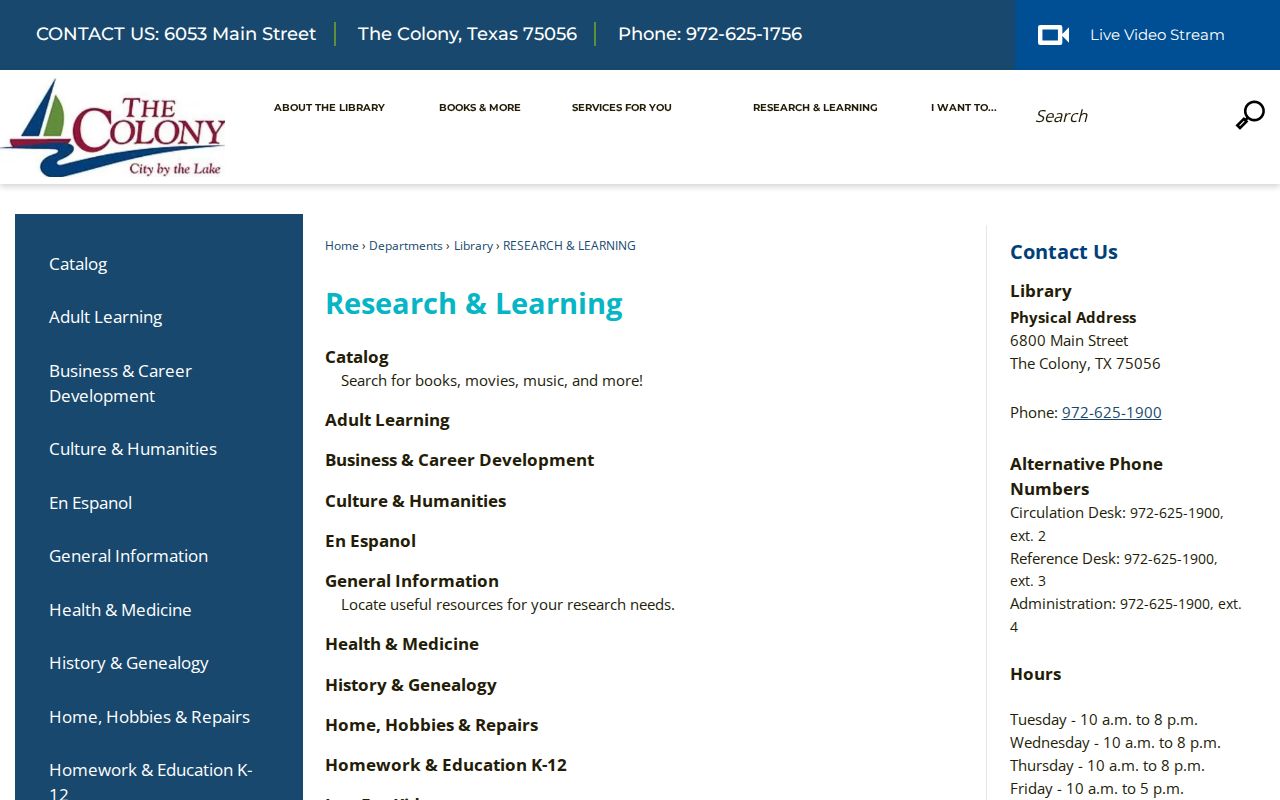
Library access matters here: Ancestry Library Edition is identified as in-library only, while America’s News, Dallas Morning News resources, and Fold3 are listed as research routes that should be checked for current availability. The reference desk is reached through the library at 972-625-1900, extension 3.
The Colony Directory Names Across Decades
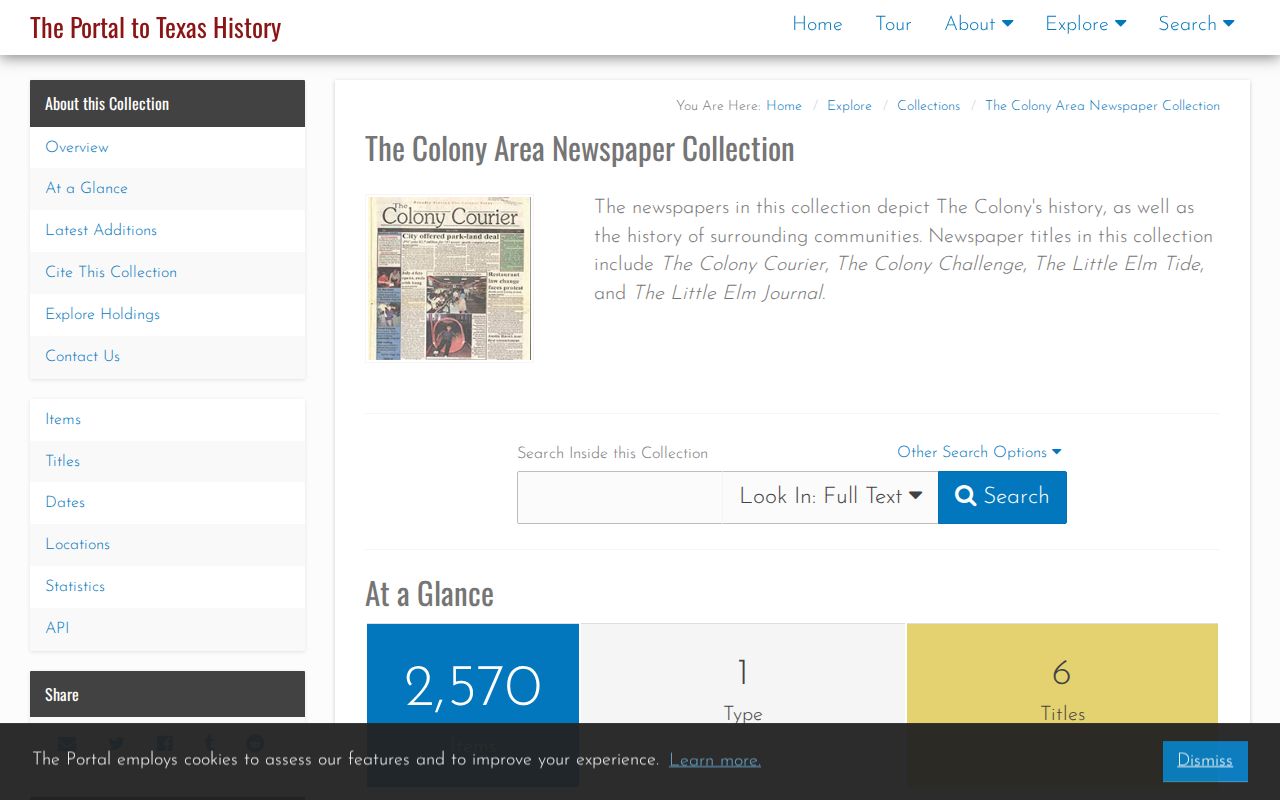
The UNT Portal’s The Colony Area Newspaper Collection supplies the most substantial local name-search layer for the city’s era. It reports 2,570 items from six titles over seven decades. The collection supports full-text and metadata searching, including names, titles, subjects, creators, and proximity searches. The Colony Courier alone is reported as 677 issues and 6,222 pages, with issues represented from 1976–1979, 1980–1988, and 1997–1999.
The collection landing page shows the title and decade filters used to narrow a historical name or event.
Unlike a directory, a newspaper result is a dated mention rather than a comprehensive list. It can supply a spelling variant, a subdivision, a civic appearance, a marriage or obituary notice, or an address clue to verify against an original page image. OCR can misread names and house numbers, so a result should be checked in the scan.
The Colony City Directory Entry Clues
The digitized 1923 Denton city directory is a useful example of what a historical entry can contain, while remaining clearly separate from The Colony. Its alphabetical entries place a person or family name first; a spouse or household relation may follow in parentheses. An asterisk records the number of children under 18. Shortened occupation terms, a business reference, and res. followed by a street address can appear in the same line. Separate civic-officer, advertising, business, and street-listing material adds context for that particular year.
| Alphabetical name | The person or family appears in surname order; check initials and spelling variants. |
|---|---|
| Parentheses | Often a spouse or household relation, which is a lead to corroborate elsewhere. |
| Asterisk and number | In the 1923 sample, the number of children under 18. |
| Shortened occupation | A period-specific descriptor such as labr. or carp.; read it with the volume’s own notation. |
| res. address | Residence followed by a house number and street, not proof of later occupancy. |
| Owner notation | No universal owner or renter mark was verified for this sample; do not infer one. |
- Criss-cross directory
- A later directory format arranged by street and number rather than surname. A criss-cross section was not documented for every local volume, so inspect the book rather than assume it exists.
- Householder index
- An index intended to identify the household associated with an address or surname. It is a finding aid, not an independent record.
- Abbreviation key
- The explanatory front matter for shortened terms and symbols. Photograph or transcribe it before interpreting a mark; the full 1923 key was not separately captured in the research.
The Colony Directory Shelf Nearby
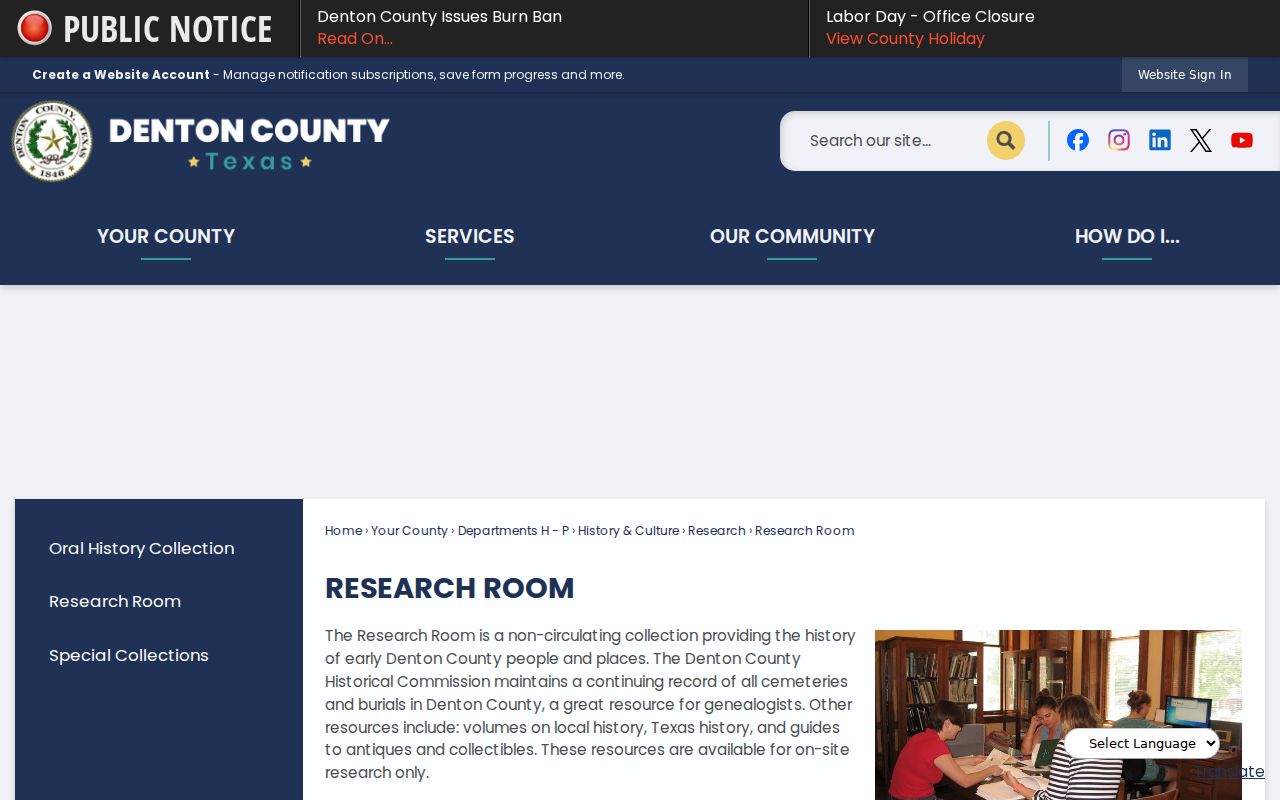
The Denton County History Research Room adds county-history books, guides, cemetery and burial research, and the physical Denton and Lewisville directory holdings. It is the fallback when a digitized image is incomplete or a family predates The Colony. The regional depository assignment also sends Denton County microfilm research to UNT, where older deeds, marriages, probate materials, tax rolls, poll-tax lists, district minutes, and naturalization materials provide a wider county trail.
The Research Room’s official page describes its local-history and cemetery role.
County research should be date-sensitive. A Denton directory entry cannot establish that a person later lived in The Colony, and a newspaper notice from The Colony does not automatically identify a person in an older Denton entry. Keep the source city, issue date, and page or image reference with each clue.
UNT’s regional-depository role also supplies a concrete pre-directory fallback: Denton County deed records are listed for 1854–1855 and 1875–1902, marriage records for 1875–1905, probate minutes for 1876–1931, tax rolls for 1846–1910, and poll-tax payer lists for 1938–1947. Those microfilm groups can help place a family in the county before The Colony had streets or municipal institutions. They are historical evidence with their own coverage gaps, not retroactive city-directory entries.
The Colony Records at Bridges Cemetery
Bridges Cemetery supplies a distinctly local historical anchor, not a searchable resident list. It occupies land associated with William Bridges’ 1850 Peters Colony grant and preserves the memory of the Bridges Settlement. The cemetery is closed except for its annual spring opening or a virtual-tour route; no public online index of interment names was found. The library, Local History Committee, Texas Historical Commission marker, and county-history channels are more appropriate starting points than an assumed database search.
This is also a useful correction to the “one shelf has everything” idea. Cemetery, newspaper, directory, deed, and vital sources each answer different questions and may disagree on a spelling or date. Retain the original wording when historical terminology is necessary for source fidelity, and add context rather than treating old labels as current descriptions.
Trace The Colony Directory Clues
A defensible household trace uses a chain of dated records, not a single name hit. Start with the most exact clue available: an address, a newspaper date, a spouse name, or a neighboring-city directory entry. The goal is to decide whether successive records describe the same household, not to force every same-name result together.
- Copy the name, address, year, page image, and any household notation from a directory or newspaper result.
- Search initials, married or maiden variants, alternate spellings, and number formatting. Historical OCR can split names or read numerals incorrectly.
- For a Denton directory, move between the alphabetical entry and any street material present in that particular volume; then record what the book actually says.
- Pair the directory year with the corresponding federal census year, such as a 1920 directory with the 1920 census. Compilation timing and coverage differ, so treat the pair as corroboration rather than identity proof.
- For post-1974 The Colony, search the Courier collection and library sources, then follow a property, deed, plat, probate, or vital-record lead through the proper custodian.
Disappearance is not a conclusion. A person may have moved, died, appeared under a different spelling, become unlisted, or fallen outside the source’s geography. Eastvale’s 1987 consolidation also means a family can appear under Eastvale, Lewisville, Frisco, or a rural description at different points in the local timeline.